Starting off the new semester has gone well. I feel like I've gotten back into the flow of things, which has been good. Last semester my goal was to get my Private Pilots license by Christmas, a goal which I effectively achieved. I am very grateful that this happened, for I think if I would have taken my checkride after a three week break, I would have needed a few review flights. Now the challenge for me is to push myself in my instrument studies. The first part of my life long dream has been fulfilled. I hold a private pilots license. The temptation will be complacency, something which I would rather live without. I am confident with lots of focus, passion, and good weather I can tackle the challenges of instrument flight without a problem.
I have started instrument ground school but unfortunately haven't had the chance to fly yet. This entire week has been foggy or overcast. You might ask why I'm not flying. After all I AM learning instrument flight, why not go up in instrument conditions? Flying in IMC (Instrument Meteorological Conditions) required IFR clearance, and working with that while training is quite difficult. There will be a time, a little later, where we will fly actual, but for now we need to wait for a clear day.
Amy is my instructor again and she informed me that the instrument rating is achieved a lot quicker than the private pilots license. She estimates, if the weather cooperates, that I could be finished with it around spring break in March. Lets hope so!
Monday, January 18, 2010

Wednesday, December 16, 2009
Private Pilot!
I now write as a private pilot! It is amazing, but not hard to believe that I was able to fulfill my goal of getting my license in one semester. Earlier on I was doubtful, as the weather for a couple weeks in a row just didn't cooperate. And with my busy schedule at school, my goal seemed a bit to ambitious. But, like I said in my last post, effective time management and motivation can go a long way in accomplishing your goals.
I had initally scheduled my checkride for early Monday (14th), but low ceilings moved it to Wednesday. Tuesday evening it took me quite a while to fall asleep. I was up early wed. morning ready to go. I was extremely nervous, but the entire thing went really well! The examiner, Dr. Lay, briefed me before we started on the order of events and then we started the checkride. It started with an oral exam, which took about 45 min and then we headed out to the plane for the practical test. During that flight, from the moment we stepped into the plane, I was being watched on how I handled every stage of the flight. This was the final examination, and he tested me in every element I learned this semester. When it was over, we parked at the hangar, had a postflight debriefing with my instructor and he signed a temporary license for me. Let me tell you, I was quite excited when he pushed the paper across the table, smiled and ask me to sign on the line. I was a private pilot!! Dr. Lay said it would take 110-120 days for me to receive the actual card. This is the Federal Government we are talking about. I sure hope I get it by then.
Next semester I will start right away on getting my instrument rating. But for now, I'm kicking back and enjoying the Christmas Break. So until my next post, have a Merry Christmas and a holiday.
Thursday, December 3, 2009
Time Management
Once again I'm afraid I will have to start my post with an apology. These last few weeks have been crazy and the workload keeps piling. So I'm sorry it has taken this long to post. There are about two weeks left in the semester and I'm finding that all of my work is catching up to me. Papers have been assigned and finals need to be studied for. But most important of all, I have my FAA written exam and checkride fast approaching.
I have been studying for both like a madman, whilst juggling all of my other school work. I have also been progressing through Stage 4, the final stage, quite quickly. My first night flight was Monday, and I had a night cross country last night to Wichita. It was my first time flying into class C airspace and what and experience! On approach the tower told us to keep our speed up, as a Learjet was on final behind us. So we flew the approach right below the yellow arc at 120 knots. Fortunately Wichita's runway is long enough we didn't need to worry about our ground roll distance, so speed wasn't a critical factor.
I have another night cross country tonight with a local solo tomorrow. I am working on polishing up my maneuvers and cross wind landings so they are in tip top shape for my checkride. I must admit I'm quite nervous. But I might as well get used to it, since I know I'll have many more to come!
Friday, November 20, 2009
Stage 3 complete!
Today I completed stage 3! Monday I finished my final solo cross country. The weather was great at Newton, but I was flying to Topeka, Manhattan, and then back to Newton. The further east I got toward Topeka, the more the ceiling closed it. It was down to a bout 2000 ft as I was 20 miles out, so I told flight service it was looking a little to iffy for me as a student pilot and that I wanted to go direct Manhattan. I adjusted my heading and flew pretty much straight there. I was pretty proud of my pilotage skills. I wanted to make sure, however that I SAW the runway and didn't miss it because immediately on the other side of the airport is a restricted area. I didn't want to become one of those general aviators who was intercepted by an F15 just because he wasn't paying attention.
I did two landings there and got to practice with commercial traffic in the pattern. There were a couple of US Air Beech 1900's departing around the time I was landing. It was a good experience.
Today I did a local flight with Amy, reviewing maneuvers that I haven't practiced in a while. Right as we were taxiing to take off on 35, a Chinook came out of no where, buzzed the runway, and then went back into the pattern. There was actually a stackup today! Yes, they happen even at a small airport like Newton. We waited at 35 while a Piper Aztec landed, the Chinook on final right behind him for number 2. As we taxied into position to take off, the massive twin rotored helicopter smoothly decended to about 10 feet off the grass and hovered there, slowly turning. Those mammoth beast of machines fascinate me.
After we finished our flight I was watching another aviation student flying on the sim when Amy said "There was something BIG that just landed, you guys might want to go take a look." We both ran out onto the tarmac and saw a Gulfstream III taxiing to the FBO. It stopped there for 5 min or so and then taxiied to 35. We hopped in our cars and drove to a little dirt road that was right near the runway. Man, I wish I had my camera on me. Then I realized there was NASA written on the tail. Don't ask me what they were doing in Newton, but I tracked their flight using FlightAware and see that they are now heading to California.
Either way it was a great day!

Photo from Airliners.net. NASA Gulfstream, not the same one I saw however

I tracked the flight on FlightAware. NASA803
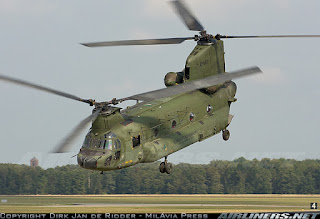
Chinook, similar to the one I saw
I did two landings there and got to practice with commercial traffic in the pattern. There were a couple of US Air Beech 1900's departing around the time I was landing. It was a good experience.
Today I did a local flight with Amy, reviewing maneuvers that I haven't practiced in a while. Right as we were taxiing to take off on 35, a Chinook came out of no where, buzzed the runway, and then went back into the pattern. There was actually a stackup today! Yes, they happen even at a small airport like Newton. We waited at 35 while a Piper Aztec landed, the Chinook on final right behind him for number 2. As we taxied into position to take off, the massive twin rotored helicopter smoothly decended to about 10 feet off the grass and hovered there, slowly turning. Those mammoth beast of machines fascinate me.
After we finished our flight I was watching another aviation student flying on the sim when Amy said "There was something BIG that just landed, you guys might want to go take a look." We both ran out onto the tarmac and saw a Gulfstream III taxiing to the FBO. It stopped there for 5 min or so and then taxiied to 35. We hopped in our cars and drove to a little dirt road that was right near the runway. Man, I wish I had my camera on me. Then I realized there was NASA written on the tail. Don't ask me what they were doing in Newton, but I tracked their flight using FlightAware and see that they are now heading to California.
Either way it was a great day!

Photo from Airliners.net. NASA Gulfstream, not the same one I saw however

I tracked the flight on FlightAware. NASA803

Chinook, similar to the one I saw
Sunday, November 15, 2009
Weather
One thing that you are forced to adapt to here in Kansas is the weather. When its sunny it is beautiful. But let me tell you, it can get quite nasty going the other way. Most of you have noticed that I haven't posted the "Solo Cross Country 2!" yet. Yes indeed. This is because of the weather.
Last Wed. I made an attempt. There was some low lying fog in the early morning but it was predicted to burn away by my departure time, as well as in the areas that I was flying to. Amy warned me that some of the fog in areas might evaporate into low lying clouds, maybe 1500 to 2000 ft. As a student pilot, I need to maintain visual contact with the ground at all times. This means I cant fly over an overcast layer. Well, I took off with the visibility about 6 miles at Newton. Along one of my checkpoints I could see the overcast layer on the right side of the plane stretching over the city that was my checkpoint and then eventually curving in front of me 30nm miles in front. I tuned to an AWOS at an airport in the cloud layer and it reported them at about 1400 ft. The left side was completely clear, so it was like a wall of clouds.
Well I decided to turn around because I would eventually be forced to fly over this cloud layer to get to Topeka and thus would obscure my vision to the ground. I told flight service of my intentions and headed back to Newton. Except that unforecasted clouds (scattered) had moved in over Newton and the visibility had dropped to about 5 miles or so. The clouds were hanging right at minimums. So I basically scud ran it into the airport. I thought about landing at another airport, but I was within legal limits so I decided I might as well bring the airplane back to the hangar.
This was my first encounter with weather, and I'm sure it wont be the last.
As for the cross country, I'm sure I'll get it done wed morning. That is when I am scheduled to fly again. We'll see. It is supposed to snow tomorrow and Tuesday so we'll see how that works out.
Saturday, November 7, 2009
First Solo XC
Today I completed my first solo cross country flight. First I should define "cross country" for those who are reading. In the Hesston College Aviation Program, cross country flight is simply any flight that is 50 nautical miles or more away from the airport of origin.
Today I flew from Newton (KEWK) to Hays (KHYS) to Hutchinson (KHUT) and then back to Newton. The preflight went as usual. Preflight for xc (cross country) flight takes a lot longer than a local flight. You need to plan for winds aloft which affects your true course, heading, ground speed, fuel burn and time to checkpoint. Basically speaking, then, you have checkpoints along the way that act as references to make sure you are tracking where you want to go. As a VFR pilot these are visual references like towns, bodies of water, highways, etc. Determining your location on your sectional chart by referencing it to the surroundings around you is called pilotage. It is a skill that is developed, as landmarks and other things used as references take a keen eye to identify.
Filing a flight plan is another thing that I have learned. Technically, as a VFR pilot, I am not required to file a flight plan. But I have been taught how to do it so that I am familiar with it once I start on my instrument rating. Once the flight plan has been filed, I am ready to fly!
Once in the air, opening the flight plan is quite easy. You tune your radio to a specific frequency and then contact FSS (Flight Service Station). They open the flight plan for you and give you any NOTAM's (Notices To Airmen) or TFR's (Temporary Flight Restrictions) in the planned area of flight and any other relevant data that you need. Once that is complete you can fly directly to your airport or you have the option of contacting a center and requesting flight following. Flight following is basically a radar service in a specific area. So I would tune to Wichita center and say something to the effect of "Wichita Center, Cessna niner six eight hotel charlie is climbing through five thousand, requesting flight following." Sometimes if they are busy it will take a while to get back so patience is needed. When they do come back, they might ask for your type aircraft and then they will tell you to squawk a certain code. Our airplanes are Cessna 172 type A which means they are equipped with a radio, a DME and a transponder with mode C (altitude encoding). Once you squawk that code into your transponder, you show up on their radar. In this way they can warn you of other traffic in the area and pretty much guide you along.
Todays flights went extremely well. I was very happy to fly today, as yesterdays flight was canceled because of high wind. I think I finally have crosswind landings down to a science. My landing at Hays was almost perfectly on the 500 ft markers, touching down on the right wheel first (there was almost a 90 degree right crosswind) followed by the left and nose wheel. Flying into Hutchinson, the controller gave me a straight in on runway 17 and that was nice I didn't have to work the pattern. Coming straight in really lets you use your distance judgment. You need to descend, but not to fast because you'll end up low on the glideslope. I hit it right on the money. It feels pretty good, getting the hang of this flying business.
Wednesday, November 4, 2009
Student-Pilot Student
Being a student pilot and a student at a college can be quite challenging sometimes. I have found that my schedule is packed now more than ever. Tuesdays and Thursdays are typically my busiest days. Usually I'll have a flight Tuesday morning early, say 7:30 but I'll be up much before then because I need to get out to the airport to preflight. Combined with classes all day, including ground school in the evening for 3 hours and then musical practice in the evening for another 3 hours, I am more than ready for sleep.
I have found the miracle beverage to help with grogginess in the morning. Most of you know it as coffee. Indeed that is what I call it as well. I find that, now that I am drinking it a little more regularly than I had been, the caffeine will last as long as I need it to without interfering with my sleep patterns. Up early at 6:45? No problem! As long as I've had adequate sleep the night before, coffee can give me the boost I need. The real killer though is when I have to get up at 5:45 or earlier. The cafeteria isn't usually open by then, so I have to resort to my powdered milk, water, and cereal method. My coffee is then made with those little instant packets Starbucks is handing out these days. That tastes about the same as the Folgiers coffee I get in the cafeteria. Not top grade but it gets me going.
I am preparing for my cross country solo now. I will be flying Newton --> Hays --> Hutchinson --> Newton which is about a 3 hour trip total including takeoff and landing time. I anticipate it highly and am looking forward to it. Flight planning has become easier and easier just because of the practice I've been having in ground school and with Amy. Friday looks to be a little windy, so it might have to wait until Saturday. After that solo I'll have one more solo XC and then a stage check and I'll be done with Mod 3! One more mod until my checkride and license! I added up my log book today and I have about 33 hours of flight time total so far with only about 6 PIC (pilot in command) time. But with these next two solos coming up I should get a good 5-6 hours more PIC time. The total required flight time for a Part 141 school (I can explain that later if anyone would like, just post a comment) for a student is 35 hours flight time, 35 hours ground instruction. I'll be well over that by the time I'm ready.
Subscribe to:
Posts (Atom)