Once again, it has been a while since I have posted. I got my CFI license on the 5th of August, a few weeks after my last post. To my joy, I then got hired here at Hesston College as a flight instructor intern. That's when the learning curve began. Shortly after I was hired, the new aviation freshmen at HC arrived for "Fly Larks Week." This is when all of the first year aviation students arrive a week early to get started with their flying. I can liken it to aviation boot camp. The week consisted of days starting at 7 and ending at 4. The students were divided into groups and would rotate to 3 different stations every day. There would be 2 ground school lessons and a flight, with 3 students to a group. The entire week I was assigned to the flight station. This is where the learning curve began.
Keep in mind I had only been a Certified Flight Instructor for little less than a week, and I was now having to instruct real students who were paying for flight training. And while I had "teaching experience" during my CFI training, the pressure wasn't quite so real as this. I took a deep breath and dived into the mayhem. I wont lie, by the end of the first day I fell into bed thinking "what have I gotten myself into?" As soon as I finished flying with the first group of students in the morning, the second was ready to go. I had about 15 minutes to gulp down a sandwich before I was back in the plane. This continued for the rest of the week.
That first week I got nearly 15 hours of flight time. Now if there are any professional pilots out there reading this, 15 hours is probably one shift for you. But keep in mind that I was a starry eyed CFI, green in the pants, who was now getting paid to fly. And while it was extremely exhausting, I was finally getting the flight time I wanted!
When I look back on that first week I'm amazed at how little I knew: Not in terms of flight knowledge, but in terms of teaching. I had read about teaching methods and how students learn; this was just text in my training. Now I was actually seeing breathing examples of people I had to train. These weren't just "practice students" anymore. This was the real deal, and it was my responsibility to train them to the best of my ability. As I continue to grow in my CFI position it becomes easy to be discouraged (yes CFIs are human too). But when I reflect back on that first week, I realize how far I have come since that day. And I am grateful.
Friday, December 9, 2011

Sunday, July 10, 2011
Learnin' through Teachin'
I have started my Certified Flight Instructor training in the airplane now that I am done with Commercial. It is my goal to get this done in 3 weeks or less and it seems as though this might be a possibility. The flight portion of my training is only 17 flights, 4 of which I finished it 2 days. Needless to say I'm hitting it hard. I have a dump truck load of material I need to read in that time which is not surprising considering I need to know just about all there is to know involving airplanes and flight. When I do go for my CFI checkride, it will be the hardest checkride I will have ever taken. Anything and everything is fair game for them to question me on. Even things that I have not been taught by my instructors (as I have been warned.) So, as I dive into the ocean of aviation knowledge I bid you: never fear for I shall return to the realm of blog-dom once my trials have been overcome! (Calling them trials really is misleading because I'm enjoying every minute of this!)
Catch you later!
Tuesday, July 5, 2011
Commercial Pilot!
Yes its true, I now am a commercial pilot! While this took quite some time, and posting here on blogger was few and far between, it has finally come to be. I had my checkride Saturday in and amongst Newton's Young Eagles fly in sponsored by the EAA. Needless to say the airport was unusually busy with airplanes departing and arriving constantly. It made the checkride all the more challenging, but it was something that I wasn't worried about. As I reflect on this past saturday, I can see the growth that I have achieved over these past two years as a pilot. Dealing with a busy airport was just another thing that I as a pilot will have to deal with the rest of my life. Am I okay with that? YOU BET!
Falling asleep friday night was very hard. Not just because the city of Newton lifted the fireworks ban for the weekend, but because my nerves were starting to get more..nervy as I tried remembering every conceivable thing that might be asked on the checkride. Right as I turned out the light I received a phone call. Dale, who was going to do my checkride in the morning, said he had a flight the next day to Santa Fe and was wondering if I could go with another examiner he arranged. This was fine by me, except that I knew how Dale worked because he was my examiner for Instrument. I was now going with someone who I had never met and was therefore unable to try and predict what questions he was going to ask. The tossing and turning continued for another hour.
I arrived at the airport bright and early Saturday morning with the temp already pushing the 80's. Dave arrived at 830 and we began the oral portion of the exam. It went very well. He ask me an array of questions for an hour and a half, after which all of my brain juice was wrung out on the table. It was time to fly. We got into the aluminum oven and I went through my preflight briefing. As we taxied by the FBO, we saw numerous planes of all kinds lined up on the ramp. From jets to a Fokker Triplane, people were scattered among them admiring the flying machines. I caught a whiff of barbecue as we scooted on by.
Besides the unusually busy Newton Airport, it was a beautiful day to fly! The wind was light and all of my maneuvers went well. We headed back to the airport to do my short field, soft field, and power off accuracy landings. The first two landings went well, but the last was the one I was worried about. Besides the Pylon-Eight, the 180 degree power-off accuracy landing is the hardest maneuver of commercial. It involves pulling your power abeam your landing point and gliding to a landing. It gets tricky: you have to pick a point to touch down at. If you are short, you fail. You only have a 200 foot strip beyond that point to touch down in or you fail as well. Its a very small spot on the runway, and you have to hit it without using any power. Its also difficult to practice because different days have different speeds which change your descent rate. The judgement comes in when you turn on the base leg, and you can determine if you are to high or to low, If you are too high, you can add in flaps, do a slip to get down. If you are too low, you can pull your prop control back which adjusts the propeller to a high blade angle (this reduces drag). You can also add flaps in at last minute which will cause you to balloon, but you'd better know you are coming down after that. Needless to say this was a maneuver that I had been struggling with. To make a long story short, I nailed it and breathed a sigh of relief as we came to a stop on the runway.
Now that I have my commercial pilots license, I'm starting to work on instructor. I'm aiming to get it done by the end of summer (hopefully sooner) but the experience I've had so far tells me that I'll just have to go with the flow and see what happens. I'll do what I can to keep this thing updated. So for now its an adieu and thanks for reading!
Falling asleep friday night was very hard. Not just because the city of Newton lifted the fireworks ban for the weekend, but because my nerves were starting to get more..nervy as I tried remembering every conceivable thing that might be asked on the checkride. Right as I turned out the light I received a phone call. Dale, who was going to do my checkride in the morning, said he had a flight the next day to Santa Fe and was wondering if I could go with another examiner he arranged. This was fine by me, except that I knew how Dale worked because he was my examiner for Instrument. I was now going with someone who I had never met and was therefore unable to try and predict what questions he was going to ask. The tossing and turning continued for another hour.
I arrived at the airport bright and early Saturday morning with the temp already pushing the 80's. Dave arrived at 830 and we began the oral portion of the exam. It went very well. He ask me an array of questions for an hour and a half, after which all of my brain juice was wrung out on the table. It was time to fly. We got into the aluminum oven and I went through my preflight briefing. As we taxied by the FBO, we saw numerous planes of all kinds lined up on the ramp. From jets to a Fokker Triplane, people were scattered among them admiring the flying machines. I caught a whiff of barbecue as we scooted on by.

Besides the unusually busy Newton Airport, it was a beautiful day to fly! The wind was light and all of my maneuvers went well. We headed back to the airport to do my short field, soft field, and power off accuracy landings. The first two landings went well, but the last was the one I was worried about. Besides the Pylon-Eight, the 180 degree power-off accuracy landing is the hardest maneuver of commercial. It involves pulling your power abeam your landing point and gliding to a landing. It gets tricky: you have to pick a point to touch down at. If you are short, you fail. You only have a 200 foot strip beyond that point to touch down in or you fail as well. Its a very small spot on the runway, and you have to hit it without using any power. Its also difficult to practice because different days have different speeds which change your descent rate. The judgement comes in when you turn on the base leg, and you can determine if you are to high or to low, If you are too high, you can add in flaps, do a slip to get down. If you are too low, you can pull your prop control back which adjusts the propeller to a high blade angle (this reduces drag). You can also add flaps in at last minute which will cause you to balloon, but you'd better know you are coming down after that. Needless to say this was a maneuver that I had been struggling with. To make a long story short, I nailed it and breathed a sigh of relief as we came to a stop on the runway.
Now that I have my commercial pilots license, I'm starting to work on instructor. I'm aiming to get it done by the end of summer (hopefully sooner) but the experience I've had so far tells me that I'll just have to go with the flow and see what happens. I'll do what I can to keep this thing updated. So for now its an adieu and thanks for reading!
Sunday, April 17, 2011
Lesson Plans
I'm still plugging away at Commercial flight, but on the ground school side of things I am starting heavy work on becoming a Certified Flight Instructor (CFI). Part of my curriculum in becoming a CFI is making lesson plans. With these lesson plans I will be able to, in effect, teach all of Private Pilot and Commercial Pilot Single Engine Land under Part 61. This is of course if I choose to start my own flight school after becoming CFI. Chances are I'll be hired by a pre-existing flight school who will have their own curriculum that I follow. Anyhow, creating these lesson plans is a great way for me to review and prepare to teach!
So, here comes the clarification paragraph, for those who are wondering where I am at. I have finished my Commercial Flight ground school portion, and completed the written test. I am finishing up my flight hours for Commercial as well working on the ground portion for CFI. Once I have my Commercial Pilots License, after taking my checkride, I will start on the flight Portion for CFI. I will be staying into the summer here at Hesston to finish that up.
So, here comes the clarification paragraph, for those who are wondering where I am at. I have finished my Commercial Flight ground school portion, and completed the written test. I am finishing up my flight hours for Commercial as well working on the ground portion for CFI. Once I have my Commercial Pilots License, after taking my checkride, I will start on the flight Portion for CFI. I will be staying into the summer here at Hesston to finish that up.
Saturday, March 19, 2011
Its been a long road... Gettin' From there to Here..
Tweet
Can you place the title? I know a few of my readers will be able to. The song came into my mind as I was landing on my final cross country of stage 2. I needed 3.7 hours to finish up and as I shut the engine down, I smiled to myself as I noted I had completed 3.8 hours flight time. I also had completed my 5 additional stop-and-go's at a towered airport at night. I was all set to jet! (That is a figurative form of speech, I will not be able to fly jets for another few years.)
I had planned a flight to Hays, Hutchinson, and back. I have attached a photo on the bottom. As you can see the red line was my planned flight route, and the blue was my actual route of light. And that yellow box that is smack dab in the middle of where I was planning to fly? That is an MOA (Military Operations Area), or Monkeys On Assignment. As I took off into the sunset, I did my regular routine of filing a flight plan and contacting Wichita Approach who then handed me off to Kansas City Center (KCC).
"Niner Hotel Charlie, the Bison and Smoky MOA's are active including the Restricted Airspace west of Salina, were you planning on going through that?" I now had a choice. I could fly through the MOA but I wouldn't receive any radar service because KCC didn't want to be responsible for any abrupt encounters with an F-18 or two. Or I could go around north of the MOA to Hays, which I chose to do because it would add some time to my flying, time I needed to get done. I did some rough fuel calculations and determined I had enough for this detour and back to Newton with remaining reserves to spare.
The detour was pleasant enough, and included flying over a huge wind farm. I always find wind farms interesting at night. All of the windmills have red blinking anti-collision lights on top of them, and they all blink at exactly the same time. It looks like a pulsating field of red orbs. I did some stop-and-go's at Hays and then headed to Hutchinson. I pulled out my AF/D and realized that, with the time change, the tower at Hutch was now closed. Angry at myself for not realizing this, I informed KCC I wanted to head to Salina and do some stop-and-go's there. I headed back around the Big Blunder of an MOA (BBOAMOA) and did my 5 at Salina. As I landed the first time, I smelled jet fuel. As I was taking off again I noticed two F-18's sitting on the apron taking on fuel. So you are the guys who were hoggin' the airspace. I thought to myself. However, in the long run I wasn't too upset. These series of events turned a supposed 2 hr flight into a 3.8, just enough for what I needed. I was glad I didn't need to fly another one and was able to now move ahead.
In the coming days I will be flying lots of dual flight with my instructor to finish up stage 2. Some of this will include flying actual IFR with my instructor for more practice. Stay tuned for more posts!

Friday, March 18, 2011
Catching up
Hey, just a quick update: I will post soon about last nights flight which was interesting and also the last cross country flight for Commercial! Right now I really need to focus on flying as much as possible as well as reading loads of material. My CFI ground school will be starting soon. I need to get in 45 hours of ground school in less than 8 weeks, so I'm going to be slightly busy. However, stay tuned because I will find time to blog! I have made that vow already. Thanks for hanging in there!
Friday, February 25, 2011
Chapter 12
Tweet
Prologue:
If you have noticed a lack in posting recently, its because I have not been able to fly for about a month. This was due to many factors, mainly my busy schedule as well as winter weather changing at last minute. But finally the day came when I could complete my long awaited cross country to Colorado. This is entitled Chapter 12 because of its length. If you read it as a chapter of a book, It might not seem so long.
Chapter 12
I was scheduled for a Tuesday afternoon-into-night flight. Planning to be wheels up by 3:30. Brett, my instructor, checked over my flightplan and signed me off and gave me the keys. At 3:00 I had my preflight complete and keys in hand; right on schedule. I fueled up the plane, did one last walk around and was off the ground by 3:30. After climbing to 4,000 ft around the traffic pattern (I had a great headwind!) I contacted flight service (FSS) and filed a flight plan. In the past I would have normally filed online using DUATS. But I have come to notice that sometimes the flightplans aren't always submitted right away and the response back from FSS is "Uh... niner hotel charley we aren't showing a flightplan to that destination.. would you like to file one now?" I have decided that from now on, its better to file one via human interaction than interaction with a machine.
After filing, I contacted Wichita Departure and got radar service to La Junta, Colorado which was my destination. After settling into cruise at 8,500 ft, I surveyed the landscape below. It was a fine sunny Kansas afternoon and I was extremely happy to be flying again! I trimmed out the airplane and took a bite out of a Chewy bar that was included in my sack supper. I glanced over at the GPS and groaned. It was showing my groundspeed was at 65 kts. Considering our 172's cruise at about 110 kts (in a no wind situation), this was a snails pace. I must have had a monster headwind. I mentally steeled myself for a long trip.
About 2 hours into the flight the wind switched to a right quartering tailwind. I know this because I was just passing Garden City KS when I noticed my crab angle was to the left and pretty big. My groundspeed had also increased to 80-90 kts fluctuating. This was good! I would now get there faster. The sun was beginning to set on the horizon by the time I was handed off to Denver Center. It was a beautiful sight! The sky turned a deep red and framed in the distance were the Rocky Mountains shooting up from the plains. I mentally kicked myself for not bringing my camera along (sorry!).
I was about 50 miles out from La Junta when a thought struck me. Its pretty late. I thought. I really hope the La Junta FBO is still open to give me fuel. I looked quickly in my AFD and noted the time. "Open from Sunrise-0000Z" Shoot! It had just closed! I quickly looked at the Lamar airport and saw that it was open for another half hour. I was coming up on it in about 20 miles, so I quickly radioed Denver center and told them my flightplan was changing. I squawked VFR and then radioed the FBO. Fortunately there was someone there to fuel me up. I can't imagine what would have happened if I wouldn't have been able to get fuel.
The approach to landing was interesting. Since the airport was at almost 5000 ft elevation, my approach speed was faster. The air is less dense at higher altitudes, so the airplane needs to go faster through the air to produce the same amount of lift. The indicated airspeed (the airspeed you read on the airspeed indicator) will always remain the same since the pitot tube is measuring ram air (that is air that is being forced into the instrument to measure airspeed). I had to make sure I stuck to reading my instruments rather than focusing on how fast I was going, otherwise I would have stalled.
I took on fuel and ate my sack supper watching the sun set over the Colorado plains. The guy at the FBO said I had been the only plane that day. Must be pretty quiet there! I didn't take to long of a break because I wanted to make sure I could do a couple stop-and-go's at Garden City on the way back. Part 141 of the FAR's (Federal Aviation Regulations) say I have to do 10 landings at a towered airport at night. I decided I would do 5 there and 5 on the next night cross country. I took off from Lamar and had a great tail wind to Garden City.
Apart from a Beechjet taking off while I was on approach, there wasn't any traffic as I started my 5 stop-and-go's. There was a wind of 19 kts 10 degrees off runway heading, and so that made it a lot more interesting. After completing them I headed back to Newton. The last 2 hour leg of the flight was uneventful.
I have decided that night flying is my favorite type of flying. Way up in the air, you are graced with the beauty of lights below and a sense of freedom. You are in your own little peaceful capsule with the soothing voices of center control to keep you company. You bond with your machine as it drones into the night, knowing that it is the steed upon which you depend. You fly in solidarity; but not really because you know there are others up there who are sharing the same experience. And that makes you feel warm inside. The only other way I can describe it is sitting next to a warm cozy fire with a blanket and a cup of hot cocoa. And after all this is complete, coming home after a six hour flight is the best feeling in the world.
Prologue:
If you have noticed a lack in posting recently, its because I have not been able to fly for about a month. This was due to many factors, mainly my busy schedule as well as winter weather changing at last minute. But finally the day came when I could complete my long awaited cross country to Colorado. This is entitled Chapter 12 because of its length. If you read it as a chapter of a book, It might not seem so long.
Chapter 12
I was scheduled for a Tuesday afternoon-into-night flight. Planning to be wheels up by 3:30. Brett, my instructor, checked over my flightplan and signed me off and gave me the keys. At 3:00 I had my preflight complete and keys in hand; right on schedule. I fueled up the plane, did one last walk around and was off the ground by 3:30. After climbing to 4,000 ft around the traffic pattern (I had a great headwind!) I contacted flight service (FSS) and filed a flight plan. In the past I would have normally filed online using DUATS. But I have come to notice that sometimes the flightplans aren't always submitted right away and the response back from FSS is "Uh... niner hotel charley we aren't showing a flightplan to that destination.. would you like to file one now?" I have decided that from now on, its better to file one via human interaction than interaction with a machine.
After filing, I contacted Wichita Departure and got radar service to La Junta, Colorado which was my destination. After settling into cruise at 8,500 ft, I surveyed the landscape below. It was a fine sunny Kansas afternoon and I was extremely happy to be flying again! I trimmed out the airplane and took a bite out of a Chewy bar that was included in my sack supper. I glanced over at the GPS and groaned. It was showing my groundspeed was at 65 kts. Considering our 172's cruise at about 110 kts (in a no wind situation), this was a snails pace. I must have had a monster headwind. I mentally steeled myself for a long trip.
About 2 hours into the flight the wind switched to a right quartering tailwind. I know this because I was just passing Garden City KS when I noticed my crab angle was to the left and pretty big. My groundspeed had also increased to 80-90 kts fluctuating. This was good! I would now get there faster. The sun was beginning to set on the horizon by the time I was handed off to Denver Center. It was a beautiful sight! The sky turned a deep red and framed in the distance were the Rocky Mountains shooting up from the plains. I mentally kicked myself for not bringing my camera along (sorry!).
I was about 50 miles out from La Junta when a thought struck me. Its pretty late. I thought. I really hope the La Junta FBO is still open to give me fuel. I looked quickly in my AFD and noted the time. "Open from Sunrise-0000Z" Shoot! It had just closed! I quickly looked at the Lamar airport and saw that it was open for another half hour. I was coming up on it in about 20 miles, so I quickly radioed Denver center and told them my flightplan was changing. I squawked VFR and then radioed the FBO. Fortunately there was someone there to fuel me up. I can't imagine what would have happened if I wouldn't have been able to get fuel.
The approach to landing was interesting. Since the airport was at almost 5000 ft elevation, my approach speed was faster. The air is less dense at higher altitudes, so the airplane needs to go faster through the air to produce the same amount of lift. The indicated airspeed (the airspeed you read on the airspeed indicator) will always remain the same since the pitot tube is measuring ram air (that is air that is being forced into the instrument to measure airspeed). I had to make sure I stuck to reading my instruments rather than focusing on how fast I was going, otherwise I would have stalled.

I took on fuel and ate my sack supper watching the sun set over the Colorado plains. The guy at the FBO said I had been the only plane that day. Must be pretty quiet there! I didn't take to long of a break because I wanted to make sure I could do a couple stop-and-go's at Garden City on the way back. Part 141 of the FAR's (Federal Aviation Regulations) say I have to do 10 landings at a towered airport at night. I decided I would do 5 there and 5 on the next night cross country. I took off from Lamar and had a great tail wind to Garden City.
Apart from a Beechjet taking off while I was on approach, there wasn't any traffic as I started my 5 stop-and-go's. There was a wind of 19 kts 10 degrees off runway heading, and so that made it a lot more interesting. After completing them I headed back to Newton. The last 2 hour leg of the flight was uneventful.
I have decided that night flying is my favorite type of flying. Way up in the air, you are graced with the beauty of lights below and a sense of freedom. You are in your own little peaceful capsule with the soothing voices of center control to keep you company. You bond with your machine as it drones into the night, knowing that it is the steed upon which you depend. You fly in solidarity; but not really because you know there are others up there who are sharing the same experience. And that makes you feel warm inside. The only other way I can describe it is sitting next to a warm cozy fire with a blanket and a cup of hot cocoa. And after all this is complete, coming home after a six hour flight is the best feeling in the world.
Sunday, January 23, 2011
Oklahoma!
Yesterday I had the privilege to fly to Oklahoma, Kansas' best friend. The planned route was from our home base to Ponca City, Ok to Bartlesville, OK and then back. It was an overcast day, but the lowest clouds were forecast to be 15000 during time of flight. It was a crisp winter day to fly, and quite beautiful!
Taking off from Newton we had great climb performance due to the cold air (because the air is more dense in winter, the airplane preforms better). The first leg to Ponca City was uneventful. We landed and got out and stretched. The personnel at the FBO were very friendly. Because we got there early in the morning (about 9:30) the famous Mexican restaurant that is right at the airport was closed. But I vow to return to try it sometime! Taking off from Ponca City we banked over the oil refinery that is East of the airport and started our leg to Bartlesville.
The sun was hidden by the clouds but there was exceptional visibility. Looking to the south east I could actually see the skyline of Tulsa, some 50 nautical miles away. Landing at Bartlesville, I did a touch and go and then headed back to Newton. Flying back I flew over an enormous wind farm. Investing in wind energy? Not a bad idea right now.
Over all it was a great feeling to be back in the sky where I belong!
Tuesday, January 18, 2011
Cloud Making
No, this isn't a post about the Chinese and how they can make the clouds disappear, although granted, that would be rather nice right now. No, this is just a post about why it has been cloudy the last couple of days. Looking at the ground, its hard to believe that the white fluffy stuff laying on the ground is actually water that has frozen. Yes indeed! And water means moisture. Kansas winter air is known for its extreme dryness. While it means the skin turns to a desert, it makes good flying conditions. It generally means there isn't a lot of moisture in the air to make clouds or any sort of a weather system (unless it blows in from a-way north or a-way south).
But recently, the month of January decided to do a little experiment and raise the temperature above freezing for a couple of days. "Eh... what could happen?" it thought. Well, the white fluffy stuff said "I've had enough! I'm returning to my natural state!" and little puddles (well large in some areas) started to form on the ground. But we all know how water feels when dry air is around. I mean, why swim when you can fly? Yes, those water molecules started to fly. Now we have moisture in the air.
Air cools 2 degrees C/1000 ft. Air's dew point is the temperature at which, when the air is cooled, the air will condense and ultimately form clouds (or fog if you are on the ground.) So, if the temperature is 3C and the dew point is -4C, then when the air is cooled to -4C it will form clouds. Based on what we know, that would mean the clouds would form at 4000 feet AGL.
Today, the clouds are at 2,000 ft. While the moisture is having fun flying, I am not. Since I'm not current on instrument I can't fly. Maybe I should hire the Chinese to make it rain?
Friday, January 7, 2011
Another Semester
Another semester is about to begin and I have made it my New Year's resolution to post more on this blog! The end of last semester was a combination of a busy schedule and a lazy college student, which meant that as the end of the semester approached... both of those things got exponentially worse.
Right now I am about half way through the flying portion of commercial flight. I have about 15 hours or so left of cross country hours that need to be flown. As per end of semester finals I took my FAA commercial written exam so I have that under my belt. I am incredibly anxious to get flying again!
There is one more giant task ahead of me before the semester starts, however. This is the looooooong (notice the emphasis on long) 22 hour drive back to Kansas after enjoying a wonderful Christmas break. It will not be done alone, but rest assured I will need both rest and to be alone when I get back.
Till then!
Tuesday, October 12, 2010
The Joy of Cross Country Flight
Cross country flights used to be intimidating for me. A year ago, when I was training for my Private Pilots License, cross countries were a time of weaning. It was a time when I as a student was released into the real world of aviation; hands shaking, butterflies fluttering, yet confident in the training I had received. And as I reflect on that time of weaning, I realized that many and most of those flights I did solo were not enjoyed. It was not that the flights were miserable and dreaded but that I, as a new pilot, was so focused on what I was doing I had little time to really realize that I was having fun.
Now that I am far more comfortable in command of an aircraft, I can sit back an really enjoy the flight. On Saturday I took a flight to Dodge City Regional Airport in Dodge City Kansas. This was a milestone in my career as it was the first cross country to an airport of my choice, that I planned and had never been to before. In my private training, the instructors picked the destinations and had the students plan the flight. Hesston Aviation has their "milk run" routes for cross countries which usually consist of: Newton-->Topeka (Forbes Field)--> Manhattan Regional--> Newton, or Newton--> Hays--> Hutchinson--> Newton. However, now that I am in the commercial portion, I get to choose any destination I please as long as I can get the plane back in decent time (or back before the weekend ends). So this flight to Dodge City (KDDC) was very rewarding.
The day couldn't have been more perfect to fly! And after reaching my cruising altitude, a sense of freedom overtook me. The sky was clear blue and the air was clear, I could see for miles in every direction. Little patches formed all over the terrain where farmers divided up their farms and grain elevators marked where little towns lay. I can say right then I had my "aha!" moment. I felt so free up there in that little tin can of a machine. I smiled to myself and though, "I wouldn't mind doing this for the rest of my life."
Monday, October 11, 2010
Still Here!
Hey guys! I'm still alive and well. The beginning of school has been extremely busy. I have started on my Commercial License and can tell you that flying is starting to become second nature! Right now I am in stage 2 and need 40 solo cross country flight hours. This is the fun part! I get to choose my destinations for my cross countries and am already thinking about trip to Colorado sometime. My goal is to fly as much as possible this month to try and get this stage done. My instructor Mike informed me that this is the longest part of the training because everything depends on weather and availability of planes. Because I need to fly so much, the combination of the two can mean sometimes I don't fly. As long as I am aggressive with the scheduler then the latter of the two shouldn't be a problem.
You might ask, why not go IFR if the weather is bad? Although I am instrument rated, I have never flown actual IFR, much less actual single pilot IFR. While my training means that I can fly IFR by the book, being in that setting in real life is completely different. I have set personal minimums for myself which means I am not comfortable quite yet going single pilot actual IFR until I have had a bit more experience in it. I hope this year to have plenty of opportunity to do that. IFR flight is as rewarding as it is challenging and I can't wait to do more of it!
I hope to post more in the coming days. But for now, this will have to do for a recap. Later!
Monday, May 17, 2010
Instrument Rated
Sorry this post is so late, traveling back home took 20 hours and I have been catching up on sleep for the past week. The last week of school was very hectic, trying to balance finals with getting the remainder of my flights in. But I am now an instrument rated pilot! The day of the checkride was beautiful, but with some winds that were not forecast. That, with a number of other factors including Wichita Approach denying 2 of our requested approaches threw a challenge into the mix. But at the end of the afternoon, I was all smiles with an instrument rating in hand. Well sort of, the actual card from the FAA will take a couple months to get to me.
Right before we left, I had the chance to take my father up. It was his first time flying with me, something that I have been looking forward to my whole life. It was a great experience enjoyed by all.
Now I have the summer ahead of me. This blog will most likely become quite silent until the beginning of September when I start on my commercial license. There is a chance I might be able to go flying this summer, but we'll have to see. But until then I will be flying Flight Simulator, staying sharp on my instrument scan and procedures. Until I write again, its been a great year! One down, one to go.
Tuesday, May 4, 2010
Proving Day
It has been a really busy week so far and will continue to be. I just wanted to update you readers to say "Yes! I'm still here!" This is the last week at Hesston College before I start the 20 hour drive back home. In that amount of time I will hopefully obtain an Instrument rating. Balancing studying for my written (which is tomorrow by the way, May 5 @ 8am) and my checkride among other exams has proven quite challenging. But hey, I chose this career as a pilot which will most definitely involve efficient time management. I might as well start learning the skills now! I still have a checkride date in the works, but hopefully that will be Saturday (May 8). I am nervous, but feel prepared. That is the way to go! Until next time readers, hopefully an instrument rated pilot will be writing the next post!
Tuesday, April 13, 2010
Thursday Tour
(If you haven't seen my other new post about the rally, read below)
I apologize that these posts will come out of order. But I realized that I also should be writing about the field trip that took place last thursday, the 8th. Dan, our director, arranged an all day tour to Flight Safety International in Wichita, and then the Cessna Single Engine Factory in Independence, Kansas. Both were extremely enriching experiences!
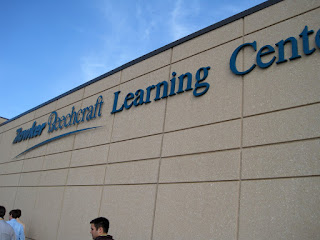
In the morning we headed to Flight Safety at the bright hour of 7oclock in the morning. Flight Safety International is like one massive flight school. Their clients are pilots with thousands of hours under their belt who need to get type ratings in specific aircraft. They have training centers all over the U.S, Europe, and Asia, with their headquarters being Wichita with six training centers. We went to the Hawker Beechcraft Learning Center where pilots come to get type ratings in all of the Beechcraft King Air series (C90, 200, 350), the Beechjet, the Premier, as well as all of the Hawker Jets (400, 750, 800, 900, 4000) and some with a variety of avionics (like the ProLine 21, or Honeywell, or Collins EFIS 85B.
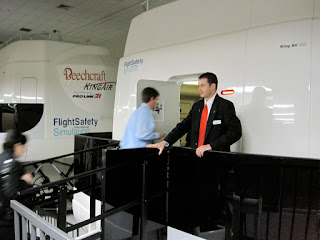
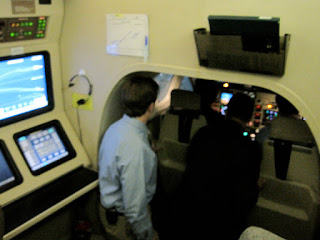
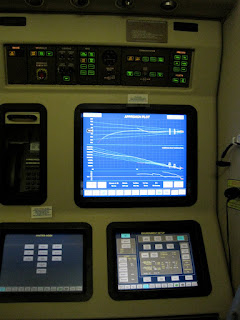
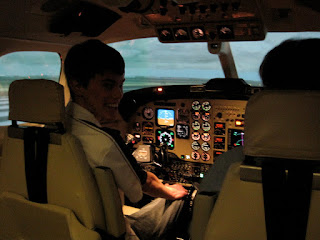
Training pilots in the actual airplane, with as many trainees as they have, is not cost effective. So flight safety has full motion flight simulators. On our tour by Mike Wallace, program manager of the Beechcraft 350 training and a 1993 Hesston Aviation alum, it was made known that a client can train all of their hours in the simulator, get their checkride in the simulator, and fly a real Beechcraft home. We were thrilled to discover that we would be given a chance to test out the simulator after the tour. At the bottom you can see me in the cockpit of a Beechcraft 350, taking off from JFK International. I am proud to say I can log 0.1 of an hour in a Beech 350! We were also excited to learn that Flight Safety offers internships mainly to Hesston and K-State aviation students. The pay is only about $15/hr, but you get free type ratings in a Beechcraft 350, and Hawker 4000, each worth about $25,000 each! I'd say thats a good deal!
After the exciting tour of Flight Safety, we headed 2 hours south to the Cessna factory. Unfortunately they didn't let us take pictures but the experience was incredible! We got a tour of the factory floor where the Cessna 172, 182, 206, 350 Corvallis, and Citation Mustang were being hand built. The manager that gave us the tour was a very friendly guy who answered all of our questions willingly. One thing that stuck out to me was what he said he looks for in a worker. He looks for the worker who goes out of his or her way to help others, and go the extra mile. He also pointed out that the floor supervisors were in there working with the workers, and weren't there just to "oversee." It was incredible for me to see a basic principle at work amongst a very powerful multi-billion dollar company: servant leadership. That really stuck with me.
We also had the chance to tour the tower facility and met a test pilot there who instructed at Hesston for a number of years. Hesston Aviation connections are everywhere! If I wasn't convinced before, I am now.
At the end of the day we climbed into the van exhausted from a tiring but rewarding day. I only hope that someday I can work as a pilot at either one of those places. I sure would be tickled pink.

I apologize that these posts will come out of order. But I realized that I also should be writing about the field trip that took place last thursday, the 8th. Dan, our director, arranged an all day tour to Flight Safety International in Wichita, and then the Cessna Single Engine Factory in Independence, Kansas. Both were extremely enriching experiences!
In the morning we headed to Flight Safety at the bright hour of 7oclock in the morning. Flight Safety International is like one massive flight school. Their clients are pilots with thousands of hours under their belt who need to get type ratings in specific aircraft. They have training centers all over the U.S, Europe, and Asia, with their headquarters being Wichita with six training centers. We went to the Hawker Beechcraft Learning Center where pilots come to get type ratings in all of the Beechcraft King Air series (C90, 200, 350), the Beechjet, the Premier, as well as all of the Hawker Jets (400, 750, 800, 900, 4000) and some with a variety of avionics (like the ProLine 21, or Honeywell, or Collins EFIS 85B.
Training pilots in the actual airplane, with as many trainees as they have, is not cost effective. So flight safety has full motion flight simulators. On our tour by Mike Wallace, program manager of the Beechcraft 350 training and a 1993 Hesston Aviation alum, it was made known that a client can train all of their hours in the simulator, get their checkride in the simulator, and fly a real Beechcraft home. We were thrilled to discover that we would be given a chance to test out the simulator after the tour. At the bottom you can see me in the cockpit of a Beechcraft 350, taking off from JFK International. I am proud to say I can log 0.1 of an hour in a Beech 350! We were also excited to learn that Flight Safety offers internships mainly to Hesston and K-State aviation students. The pay is only about $15/hr, but you get free type ratings in a Beechcraft 350, and Hawker 4000, each worth about $25,000 each! I'd say thats a good deal!
After the exciting tour of Flight Safety, we headed 2 hours south to the Cessna factory. Unfortunately they didn't let us take pictures but the experience was incredible! We got a tour of the factory floor where the Cessna 172, 182, 206, 350 Corvallis, and Citation Mustang were being hand built. The manager that gave us the tour was a very friendly guy who answered all of our questions willingly. One thing that stuck out to me was what he said he looks for in a worker. He looks for the worker who goes out of his or her way to help others, and go the extra mile. He also pointed out that the floor supervisors were in there working with the workers, and weren't there just to "oversee." It was incredible for me to see a basic principle at work amongst a very powerful multi-billion dollar company: servant leadership. That really stuck with me.
We also had the chance to tour the tower facility and met a test pilot there who instructed at Hesston for a number of years. Hesston Aviation connections are everywhere! If I wasn't convinced before, I am now.
At the end of the day we climbed into the van exhausted from a tiring but rewarding day. I only hope that someday I can work as a pilot at either one of those places. I sure would be tickled pink.


Aviation Rally
Last Saturday was the annual Larks Rally for Hesston Aviation. The entire weekend we had speakers talking about missions in aviation, not necessarily missionary aviation. One speaker shared about his witness as a captain in the airlines and how he sees opportunities to share Christ ever day. He also gave a glimpse of what the airline structure is like and how that relates to his faith.
Saturday was a nice sunny day and we were getting fired up for the flour drop and landing competition. We had seminars in the morning with various speakers. One of them pulled up mid noon in a beautiful Beechcraft Bonanza, which made our Cessna 172's look that much smaller. After a delicious barbecue lunch in the hangar, we started to preflight the planes. The wind had started to pick up, and so we hoped it wouldn't go over Hesston College standards. Unfortunately it went past 20, the limit gusting to 30 or so. After waiting 30 minutes or so it was decided that an instructor would go up with each team to ensure safety. Our team was the second off the runway. We stayed in the pattern, fighting a stiff crosswind, and made our first run in the flour drop. Needless to say dropping flower bags out of the window of a Cessna at 300 feet is a lot harder than it sounds. My teammate found it difficult to judge where the bag would fall. Sadly, none of our bags on our three runs hit the target. Travis was on the ground judging, and our team would later help him judge as the second group went up.
After we dropped our last bag we came around the pattern to do the landing competition. Once we were abeam our landing spot we were to do a power off landing. No throttle adjustments after that point, safety permitting. But the wind was so strong we needed to make our turn to the runway immediately even though it looked as if we were going to get there too soon. And boy did the wind factor in. With no power, the wind practically pushed the plane down. It was extremely hard to judge. Of our three landings we only had points on one of them. Our team came in last, but the day was still a fun experience! And I got to log 0.7 hours of free time, which is always a plus. What a day!
Monday, April 5, 2010
Piaggio Aero P180 Avanti II
A recent assignment for Instrument Ground School has peaked my interest in a very unique aircraft. I am currently writing an article on the Piaggio Aero Avanti II, one of the most intriguing business aircraft on the market. Its bold design and five bladed "push" turboprop engines give it an unmistakable look. I remember seeing it for the first time in FLYING magazine and at first I couldn't decide if I liked it or not. But that undecided feeling soon turned into a full blown fascination with the aircraft. Sure, there are the powerful and luxurious Gulfstreams, and the sleek Learjets to gawk at. But the Avanti II introduces performance, luxury, and style to the world of VIP turboprop aviation, maybe even spilling a little into bizjet territory.
I will post my article at a later date, once written. But for now I encourage you to take a look at this airplane and its features and see why I have fallen in love with this most alluring aircraft.
http://www.piaggioaero.com/#/en/products/p180-avanti-ii/overview


I will post my article at a later date, once written. But for now I encourage you to take a look at this airplane and its features and see why I have fallen in love with this most alluring aircraft.
http://www.piaggioaero.com/#/en/products/p180-avanti-ii/overview


Wednesday, March 31, 2010
Mental Check
Yesterday something interesting happened to me that I haven't yet experienced in aviation. When I got to the airport in the morning, Amy told me we were just going to preflight the plane and fly without really doing much briefing on our lesson. The winds were supposed to pick up at around 9:30 and so it was best we get in the air before that. I knew mostly how to do the approaches she was going to teach me, so I felt briefing was not necessary.
After I had the plane preflighted, I went back into the hangar to get a drink and gather my things before the flight. As Amy and I walked back out, she commented "See this?" She pointed to her hair. "Its a natural windsock. I don't think the wind is coming from 320.
AWOS (Automated Weather Observation System)is exactly what it sounds like. It reports weather at the airport like wind speed, direction, altimeter setting, ceiling (cloud layer) sky condition (visibility), etc. On this day, AWOS was reporting winds 15 knots at 320 (north being 360). Amy said "I don't think the wind is coming from 320, that just doesn't sound right." Sure enough, as we taxied to do our run up on the ramp, we looked at the windsock. The wind direction was almost 180 degrees from what AWOS was reporting!
As we started our run up (the preflight check before takeoff, usually done on the ramp or out of the way of other taxiing traffic)we heard Oliver (another instructor) and his student on final for 35. The weather was still reporting wind at 320, when in reality it was directly behind them! They were about to land in a tailwind with about 15 knots. We observed their plane coming in fast and high, a very unstabilized approach. Amy was about to inform them to go around when we saw the nose pitch up and heard the roar of the engine as the plane started its go-around. Amy, notified the FBO of the problem and then had it corrected.
What I have learned from this experience is to constantly question your surroundings. If something doesn't feel right, don't blow it off. Ask yourself if you have the right information, if you have completed all of the proper checklists, what is the situation now, and how can it change for the better or worse? If you feel uneasy about something, DONT FLY until you have identified the problem.
And by observing the other aircraft, I can affirm what has been drilled into me time and time again. If the approach doesn't feel right, go around. Don't try and salvage the landing, you might not be able to salvage the aircraft afterwords.
Thursday, March 25, 2010
Landing Competition and Flour Drop!
Each year, Hesston College aviation has missions week, where various aviation alumni come and speak on their experiences in mission aviation. The even is the entire weekend with various speakers and a meal. But the think I a personally looking forward to is the Hesston College Aviation Larks Rally. This is a time when the aviation students compete in two competitions: The Landing competition and the flour drop.
I'm not sure of all the details, so I will update you after this event takes place. I believe the landing competition is to see who can land in the shortest distance, between two markers. Either that or there is specific markers to see who can land between them. The flour drop sounds pretty straight forward in that teams will overfly the field and try to land their flower sack on a prescribed target.
I still need to get a team together, and I have two weeks to do that. The competition takes place on Saturday, April 10. Be assured I WILL post after this event to tell details and stories on what happened. I might even get some really good pictures!
Saturday, March 20, 2010
Acronyms
I apologize for my lack of posting lately. College, as it were, just gets busier as the semester goes on. However, I realize that there are those out there (namely family members) that check my blog faithfully and because of that I have decided to make it a goal to post at least once a week.
Instrument is going well, although a combination of bad weather and health have kept me from progressing as fast as I would like. I am, however, confident that I will obtain my rating within the next few weeks. Focus and determination is what is what is needed.
Before I became a pilot, I didn't think much of acronyms. To me they were just silly words that meant the person was too lazy to actually say the phrase. But in aviation, acronyms are almost essential to safety and smooth function of the flight. Acronyms in aviation serve there purpose as memorized checklists. While the same information is on a physical checklist, it speeds up the flight and reduces pilot load if you have that checklist memorized. I AM NOT ADVOCATING FOR THE MEMORIZATION OF ALL CHECKLIST MATERIAL. This is dangerous, as you might miss something vital. But there are certain elements that can be memorized using a helpful acronym.
One simple example that most pilots use is the GUMPC check. This stands for Gas (fuel selector valve set to both), Undercarriage (In the down and locked position, verifying you have a wheel on either side), Mixture (rich), Prop (spinning), Carburetor heat (on). This is used on the downwind leg to final, or at the final approach fix to final in instrument. It means the pilot can quickly have his descent checklist done without having to fumble with a card while concentrating on his approach.
My favorite by far though is the three series of acronyms used to verify that you can fly instrument. TOMATO FLAMES, FLAPS, and GRABCARD. TOMATO FLAMES is used to verify that you can fly VFR in day conditions, TOMATO FLAMES + FLAPS is used to verify that you can fly VFR night. TOMATO FLAMES+ FLAPS + GRABCARD verifies you can fly in IMC conditions (assuming you are instrument rated that is).
Here we go:
T achometer
O oil pressure gauge
M anifold pressure gauge for each atmosphere engine
A irspeed indicator
T emperature gauge for each liquid cooled engine
O il temperature gauge
F uel level gauge
L anding gear position indicator
A ltimeter
M agnetic heading indicator
E mergency locator transmitter (ELT)
S eat belts
F uses
L anding lights
A nticollision lamps
P position indicator lamps
S ource of power
G - Generator or alternator
R - Radios for navigation (ADF/VOR/GPS...)
A - Attitude Indicator
B - Ball (inclinometer)
C - Clock
A - Altimeter (sensitive)
R - Rate of Turn (or turn & slip)
D - Directional Gyro (Heading Indicator)
*another D can be added for DME or RNAV above FL240
And there you have it. Other acronyms include AROW (used to verify aircraft documents are in order), AAVIATE (verify the aircraft has had proper maintenance and inspections), UNOS (North/South Turning Error with magnetic compass), ANDS (acceleration error with magnetic compass).
I hope this has satisfied a small portion of the postings that have been lacking. Until next week! (hopefully!)
Subscribe to:
Posts (Atom)